

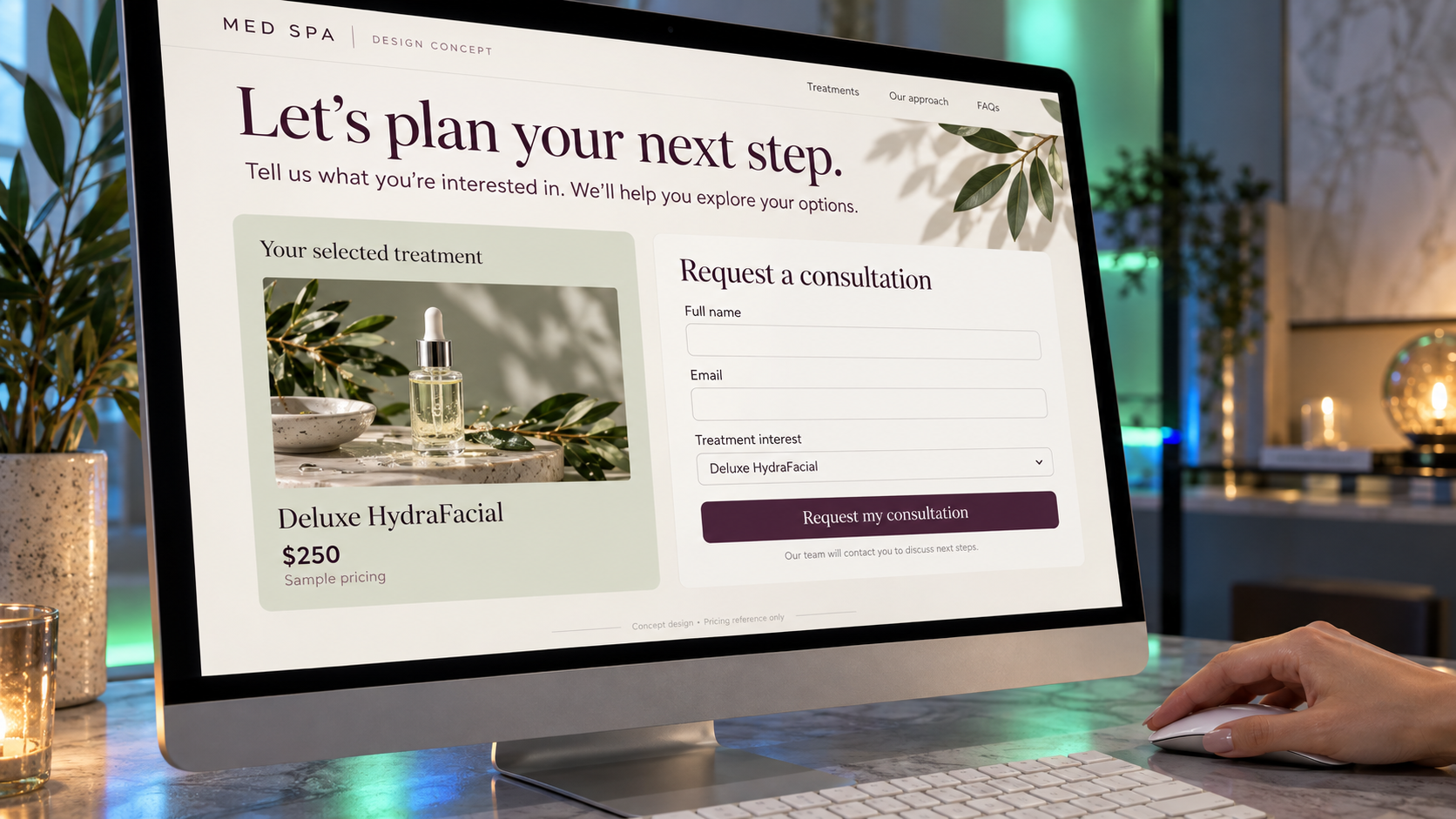
Medical spa websites designed for high conversion turn visitors into paying clients through intuitive navigation, compelling visuals, and clear calls-to-action. A well-designed site increases bookings by over 30%. Mobile optimization is critical since 68% of traffic comes from mobile devices. Speed matters, users abandon a site that loads slowly, costing the practice every visitor who leaves before seeing a treatment menu.
Why do most med spa websites fail to book?
Most med spa websites fail to book because they are built as digital brochures, not conversion engines. A high-conversion med spa website is designed to turn website visitors into paying clients by optimizing user experience to encourage bookings, form submissions, and phone calls. Without that optimization, traffic arrives and leaves without action.
The core problem is a disconnect between marketing spend and website performance. Many med spas invest in marketing but fail to convert visitors into actual patients. Increasing competition makes it essential to stand out and deliver a seamless user experience. A clinic that drives paid traffic to a slow, confusing, or untrustworthy site loses every dollar spent on acquisition.
What separates a booking website from a brochure website?
The difference comes down to design intent. A brochure site presents information. A conversion-focused site guides visitors toward a specific action.
| Brochure Website | Booking Website |
|---|---|
| Lists services passively | Encourages bookings, form submissions, and phone calls |
| Prioritizes aesthetics only | Optimizes user experience for action |
| Leaves next steps unclear | Directs visitors to clear calls-to-action |
| Treats all pages equally | Builds each page around a conversion goal |
Why does optimization matter more than traffic volume?
Traffic without conversion is wasted spend. A med spa that doubles its visitors but keeps a brochure-style site sees no proportional increase in booked appointments. The fix is med spa web design conversion work that treats every page as a step toward a paying client. Reyal Design specializes in web design and development for medical practices, crafting campaigns that help businesses connect with their target markets effectively. The agency builds sites that turn interest into revenue, not just impressions.
What makes a med spa site convert visitors?
A high-conversion med spa website combines effective design, strategic content, and conversion-focused features. These elements work together to engage visitors and motivate them to book appointments. Without these core components, medical spa owners lose potential clients to competitors whose sites guide visitors seamlessly toward a decision.
Med spa web design conversion hinges on three pillars. First, the homepage must deliver clear, compelling messaging that instantly communicates the practice’s identity, service offerings, and unique value. Straightforward headlines and highlighted differentiators answer the visitor’s unspoken question: why choose this clinic over another? Second, the site architecture needs intuitive navigation and prominent calls-to-action that reduce friction. Third, trust signals such as real patient photography and verified testimonials reassure prospective clients during their research phase.
What role does homepage messaging play in conversion?
Homepage messaging serves as the decisive moment for most visitors. A medical spa’s homepage must quickly communicate who the practice is, what treatments it offers, and why clients should choose it. Vague or generic headlines cause visitors to leave within seconds. Specific, benefit-driven copy paired with a clear unique value proposition keeps them engaged and scrolling toward a booking.
How do design and content work together to drive bookings?
Design and content function as a single conversion system rather than separate elements. Strategic content educates visitors about treatments and outcomes while effective design guides the eye toward booking buttons and contact forms. Conversion-focused features embedded within the site, such as prominent “Book Now” buttons and categorized service menus, transform passive browsing into scheduled appointments. Reyal Design delivers this integrated approach through brand refreshes, web design, and strategic communication that streamline the entire marketing process.
How does speed and mobile design affect bookings?
Speed and mobile design directly determine whether a medical spa website converts visitors into booked appointments. A slow or poorly optimized mobile experience drives potential patients away before they ever see a treatment menu or provider bio.
The numbers paint a stark picture. Users abandon a site that takes too long to load, costing the practice every visitor who leaves before engaging. That lost traffic represents real revenue walking out the door. Mobile responsiveness carries equal weight because over 68% of traffic arrives from smartphones and tablets. A desktop-only design ignores the majority of prospective patients.
Med spa web design conversion hinges on removing friction at every touchpoint. A well-designed site increases bookings by over 30% while strengthening user trust and engagement, ProspyrMed reports. Speed and mobile optimization form the foundation of that performance gain. Pages that load instantly on any device keep visitors scrolling through service galleries, reading testimonials, and clicking the booking button.
Why does mobile responsiveness matter more than desktop design?
Mobile users behave differently than desktop browsers. They search for treatments during commutes, lunch breaks, and evenings on their phones. A site that pinches, zooms, or loads broken layouts frustrates that user within seconds. The 68% mobile traffic share means a non-responsive site alienates two out of every three visitors before they consider booking.
What happens when a med spa site loads slowly?
Slow load times trigger immediate abandonment. Users leave at the point of frustration, taking their treatment spend elsewhere. Each lost visitor represents a consultation, injection appointment, or laser session that never gets scheduled. Reyal Design builds web experiences engineered for speed, ensuring pages render fast and navigation feels instantaneous across every device.
What trust signals drive online booking decisions?
Trust signals convert casual browsers into booked patients. A medical spa website lacking these elements loses appointments to competitors who display credibility at every touchpoint.
Online reviews carry weight comparable to personal recommendations, according to the Checklist for High-Converting Med Spa Websites. This insight underscores why med spa web design conversion hinges on authentic social proof. Real patient photos, detailed testimonials, and complete team bios signal transparency. Stock imagery and anonymous quotes erode confidence. Visitors scanning a site for the first time look for faces and names they can verify.
What types of social proof matter most?
Genuine before-and-after galleries carry outsized weight. Written reviews from verified patients reinforce those visuals. Team bios with professional credentials establish clinical authority. These elements work together to reduce hesitation before a prospect ever picks up the phone.
How does booking convenience affect trust?
A visible booking path signals operational competence. The same checklist notes that 70% of patients prefer scheduling online, and 32% of bookings occur after hours. A buried or absent booking button frustrates that majority. Prominent “Book Now” placement throughout the site removes friction and confirms the practice values patient time.
Reyal Design builds these trust mechanisms into every project. The company partners with ambitious brands to lift their presence, supporting in-house teams and crafting experiences that are both strategic and unforgettable. For medical spas, that means weaving reviews, galleries, and booking tools into a seamless journey from first impression to confirmed appointment.
How can you optimize navigation for more appointments?
Navigation optimization turns casual browsers into booked patients. Clear menus, categorized services, and visible booking buttons reduce bounce rates by 37%, according to a checklist from ProspyrMed. Medical spa owners lose potential revenue when visitors struggle to find treatment information or appointment options.
What menu structure works best for med spa websites?
Logical service categories guide visitors directly to relevant treatments. Grouping injectables, laser therapies, and body contouring under distinct menu labels eliminates confusion. Visitors should not hunt for information; straightforward menus paired with fast-loading pages prevent frustration and early exits.
Where should booking buttons appear for maximum conversions?
Booking buttons belong in multiple high-visibility locations across every page. A persistent header button, a sticky mobile bar, and in-content calls-to-action capture visitors at different decision stages. The 37% bounce rate reduction cited by ProspyrMed stems partly from eliminating the friction of searching for appointment links.
Reyal Design builds navigation systems that prioritize clarity and speed. The boutique creative agency applies bold, straightforward design principles to med spa websites, ensuring service menus and booking pathways feel intuitive. Award-winning campaign experience informs every structural decision.
Med spa web design conversion hinges on removing barriers between interest and action. A visitor who cannot locate pricing, treatment details, or scheduling options within seconds abandons the site. That abandonment represents a permanent loss: the patient books elsewhere, and the practice never learns why.
Mobile responsiveness amplifies navigation performance. Pages loading slowly on smartphones compound menu frustrations, driving away the majority of traffic before any content appears. Reyal Design addresses both structure and speed, creating cohesive experiences that keep prospective patients engaged through the entire booking journey.
Conclusion
Medical spas that prioritize speed, mobile optimization, and frictionless navigation convert browsers into booked appointments. The path forward demands removing every barrier between patient interest and scheduling, from responsive design that loads instantly to trust signals that confirm clinical credibility. Strategic web design isn’t optional; it’s the difference between capturing revenue and watching prospective patients book elsewhere. The decision to invest in high-converting UX directly determines whether a medical spa thrives or merely survives in an increasingly digital marketplace.