

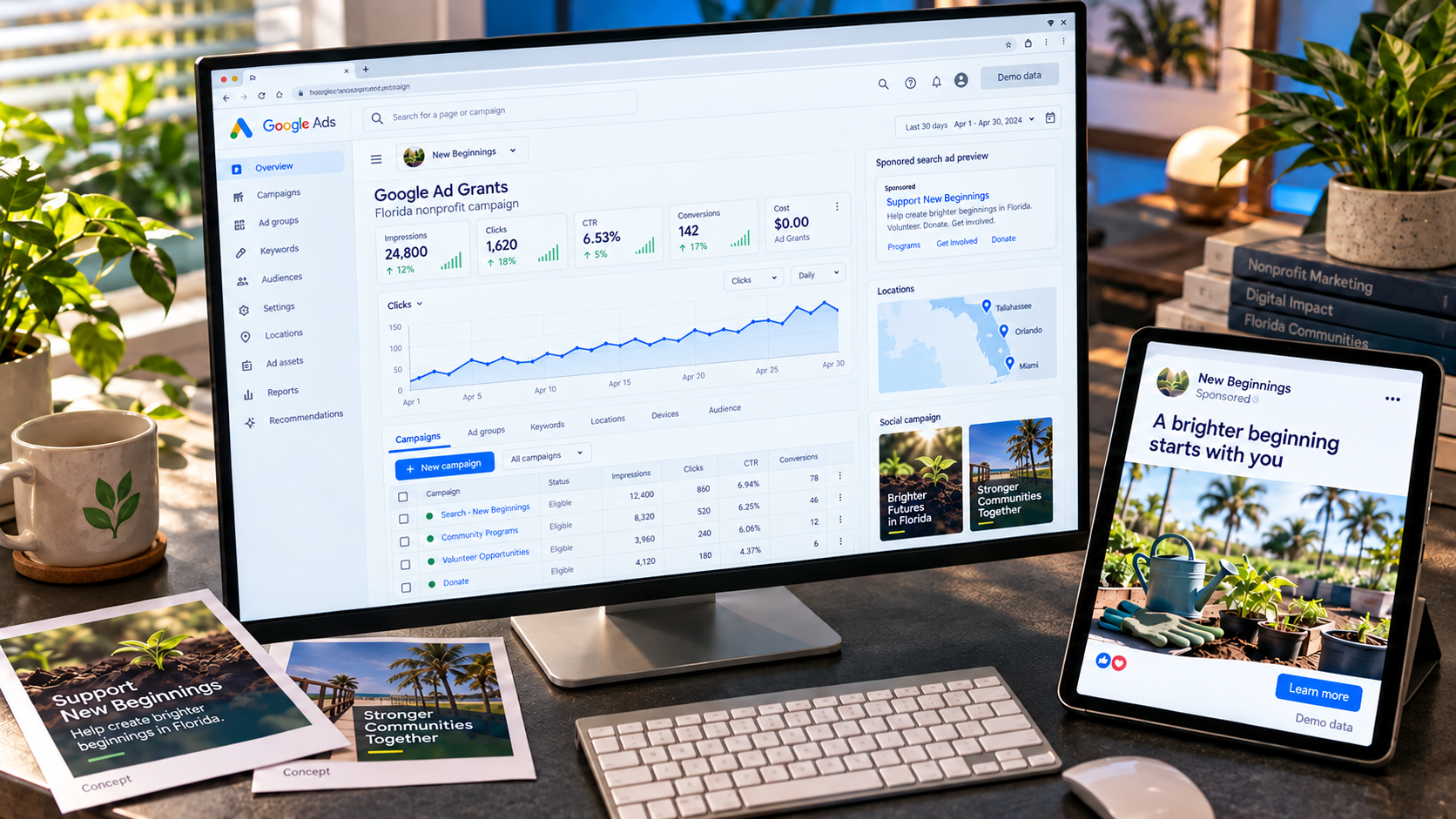
Google Ad Grants setup for Florida nonprofits delivers $10,000 monthly in search advertising through Google’s 2026 program, now verified via Goodstack. Reyal Design helps organizations build and manage compliant campaigns that align with program requirements. Florida organizations gain visibility while maintaining active grant status through strategic, AI-adapted search management.
What is the Google Ad Grant for Florida nonprofits?
The Google Ad Grant provides qualifying Florida nonprofits with up to $10,000 per month in free search advertising. That figure translates to a substantial annual advertising budget for qualifying organizations. Organizations across the state use this in-kind donation to place text ads on Google’s search results pages. The ads appear when potential donors, volunteers, and beneficiaries search for relevant causes.
A Miami-based food bank might bid on “hunger relief Florida.” A Tampa animal shelter could target “adopt a dog near me.” The grant covers only the Google Search Network. It does not fund display ads, video campaigns, or paid social media placements. While AI-powered campaign types may incorporate multi-network features, grant funding remains restricted to Search placements.
How does the Google Ad Grant help Florida nonprofits grow?
The program helps organizations promote their mission and increase visibility. Candid’s 2023 overview notes that nonprofits worldwide use the grant to connect with people actively searching for their cause. For a Florida nonprofit, this means reaching local supporters at the exact moment they express interest. A Jacksonville literacy program gains exposure when someone searches “adult reading tutors.” A Tallahassee environmental group surfaces for “Florida conservation volunteer opportunities.”
What are the key requirements to keep the grant active?
Compliance rules govern every account. Nonprofits must maintain the required click-through rate each month. Campaigns need at least two active ad groups with two sitelink extensions. Keywords must stay within the program’s maximum cost-per-click bid. Single-word keywords and overly generic terms are prohibited. Geo-targeting must focus on the organization’s service area. Accounts that fail these checks risk temporary deactivation, cutting off a significant advertising resource.
How does your Florida nonprofit qualify in 2026?
Florida nonprofits seeking the Google Ad Grant face a changed verification process in 2026. Eligibility now runs through Goodstack, not TechSoup, according to Big Sea’s 2026 Google Ad Grants for Nonprofits Guide. Organizations that miss this shift risk losing months of free advertising while applications stall.
The grant itself remains an in-kind donation worth up to $10,000 per month in search ads. Candid’s Nonprofit Google Ads 101 guide confirms the grant lets nonprofits promote their brand, programs, volunteer opportunities, and fundraisers online through the Google Ads platform. For a Florida food bank, that means ads for holiday volunteer shifts. For a Miami arts nonprofit, that means ads for gala ticket sales.
What compliance rules keep a Florida nonprofit’s grant active?
Big Sea’s 2026 guide lists five compliance areas that determine whether an account stays live: click-through rate (CTR), keyword rules, sitelinks, geo-targeting, and conversion tracking. A Florida nonprofit that ignores CTR minimums loses the grant. A nonprofit that skips sitelink extensions wastes the ad budget Google already approved.
Why do some Florida nonprofits say the grant doesn’t work?
Big Sea’s 10 Secrets to Maximizing the Google Ad Grants Program reports that many nonprofits try the grant and then say it simply doesn’t work for them. The problem is rarely the grant itself. The problem is launching without a google ad grants strategy nonprofits actually need: no conversion tracking, no geo-targeting to Florida cities, no sitelinks. Those gaps turn $10,000 in monthly ad spend into clicks that never become donors, volunteers, or event registrations.
A Florida nonprofit that treats the grant as free money loses the compliance battle. A Florida nonprofit that treats the grant as a managed campaign keeps the account active and turns search traffic into measurable outcomes.
What search strategy drives donations in Florida?
A donation-driving search strategy in Florida prioritizes high-intent keywords, strong landing pages, and AI-powered campaign tools. Nonprofits that adapt to changes in search behavior and embrace evolving AI features still see strong results.
Google ad grants strategy nonprofits succeed when organizations stop chasing broad informational queries. AI Overviews are reducing clicks on informational searches, which means Florida nonprofits lose visibility on generic terms. The fix is targeting searches that signal immediate intent to give, volunteer, or attend.
Why do informational keywords underperform for Florida nonprofits?
Informational searches increasingly end inside AI Overviews without a click. Google added AI tools to help nonprofit ads stay visible, but the shift rewards transactional language. A Florida food bank gains more from “donate to Miami food bank” than from “what is food insecurity.”
Which campaign types broaden visibility across Google?
Performance Max and AI Max are AI-powered campaign types that broaden ad visibility across Google, including within AI Overviews. Florida nonprofits using these tools reach donors across Google’s network without managing separate campaigns.
A practical Florida strategy combines three elements:
- High-intent keywords tied to specific Florida cities and causes
- Landing pages that load fast and match the search query exactly
- AI-powered campaign tools that extend reach into AI Overviews
Nonprofits that adapt to these shifts still see strong results. Those that ignore AI Overviews lose clicks they never see reported.
How do you set up and manage the grant?
Setting up a Google Ad Grant requires a structured approach spanning measurement, campaign architecture, and ongoing optimization. Without a clear google ad grants strategy nonprofits can execute, organizations risk losing the $10,000 monthly allocation through compliance failures. Big Sea’s 2026 guide outlines a practical playbook covering measurement setup, campaign structure, keyword strategy, bidding, assets, and optimization cadence. This free advertising resource drives significant traffic, engagement, and conversions when paired with the right tools and discipline.
What measurement setup is required before launching?
Nonprofits manage grant-funded campaigns through the Google Ads platform. Conversion tracking must be configured before any ad goes live. Organizations that skip this step operate blind, unable to prove impact or maintain the required performance thresholds Google enforces.
How should campaigns be structured for compliance?
A compliant account organizes campaigns around specific organizational goals. Each campaign needs at least two active ad groups, relevant sitelinks, and geo-targeting that focuses on Florida communities the nonprofit serves. Keyword strategy follows strict rules: no single-word keywords, no overly generic terms, and a maintained click-through rate above the required threshold. Bidding operates on a maximize conversions model within the grant’s cost-per-click cap. Reyal Design streamlines this setup process, delivering top-tier strategy without the overhead that burdens lean Florida nonprofit teams.
The optimization cadence demands monthly attention. Stale keywords drag down account performance and trigger Google’s automatic suspension protocols. Active management keeps the grant delivering qualified visitors to volunteer sign-up pages, donation forms, and program information.
Is the Google Ad Grant still worth it?
The Google Ad Grant remains effective in 2026 when paired with the right strategy. Nonprofits that adapt to evolving search behavior and embrace the program’s AI-powered features continue to see strong results. Organizations without a deliberate approach, however, lose valuable visibility and donor engagement that competitors capture instead.
The program is often misunderstood or underutilized by nonprofit organizations. Many Florida nonprofits activate the grant, struggle with compliance rules, and abandon it, leaving up to $10,000 per month in free advertising spend untouched. That unspent budget represents missed volunteer sign-ups, unfilled donation forms, and program awareness that never reaches the communities who need it most.
What makes the grant effective in 2026?
Success hinges on strategic campaign management rather than passive ad placement. A well-structured Google Ad Grants strategy for nonprofits includes conversion tracking, keyword refinement, and regular optimization. Without these elements, campaigns drift into low click-through rates and eventual account suspension.
Who benefits from professional grant management?
Nonprofits across Florida gain an edge when they treat the grant as a serious marketing channel. Reyal Design partners with ambitious brands to improve their presence and supports in-house teams with campaign strategy. The company specializes in industries such as restaurants, medical practices, and nonprofits, crafting campaigns that connect with target markets. For development managers stretched thin by daily operations, that external expertise prevents the grant from becoming another underperforming line item.
Conclusion
The decision for Florida nonprofits is straightforward: treat the grant as a managed campaign or leave $10,000 in monthly visibility on the table. Organizations that commit to conversion tracking, high-intent keywords, and AI-powered campaign types turn free ad spend into donors, volunteers, and event registrations. The next step is auditing the account against compliance rules and optimizing before Google’s suspension protocols intervene.