

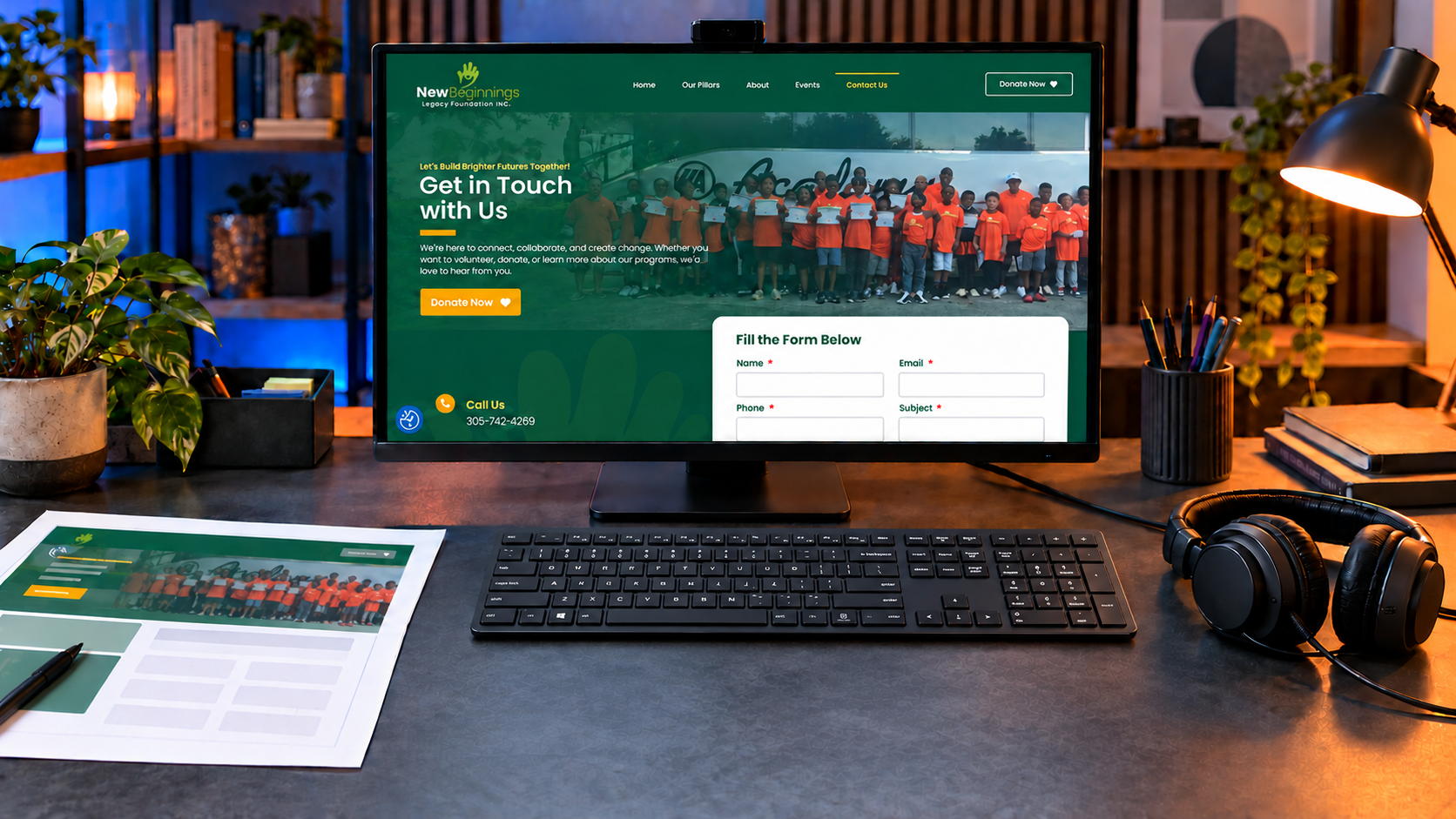
Charitable organizations must follow WCAG 2.2 regulations to ensure website accessibility for all visitors. Nonprofit websites often serve as first touchpoints for supporters, so excluding users creates liability and damages relationships. Reyal Design, a boutique creative agency, partners with nonprofits to build compliant, user-friendly websites that protect missions and expand online engagement.
Why Does Nonprofit Website Accessibility Matter?
Nonprofit website accessibility determines whether an organization’s digital presence welcomes every potential supporter or silently turns them away. A charity’s website functions as the cornerstone of its marketing strategy and the first touchpoint for donors, volunteers, and community members seeking to engage with a mission. When that website fails accessibility standards, the organization forfeits connections before conversations ever begin.
The stakes extend beyond user experience. According to BoardEffect, accessible websites see 23% more organic search, rank for 27% more keywords, and experience a Domain Authority increase of nearly 20%. Those numbers translate directly into broader reach for charitable organizations competing for attention in crowded digital spaces. Meanwhile, 75% of digital experience professionals across industries believe accessibility drives revenue, per the same BoardEffect report.
What Risks Do Inaccessible Nonprofit Websites Carry?
Inaccessible web content denies people with disabilities equal access to information. The U.S. Department of Justice guidance on the ADA draws a clear parallel: a website that excludes visitors functions the same way a staircase blocks someone who uses a wheelchair from entering a building. For charitable organizations built on inclusion and service, that barrier contradicts the mission itself.
How Does Accessibility Affect a Nonprofit’s Online Visibility?
Search engines reward accessible design. A site meeting WCAG standards earns higher rankings, more keyword coverage, and stronger domain authority. Charitable organizations that ignore these standards lose search visibility competitors will capture, shrinking their supporter pipeline month after month.
What Does the ADA Require for Charities?
The Americans with Disabilities Act (ADA) requires businesses open to the public to make their websites accessible to people with disabilities. For charitable organizations, this means digital properties must accommodate visitors regardless of ability, as outlined in federal guidance from ADA.gov. Nonprofits that overlook these obligations risk legal exposure and alienate the very communities they aim to serve. One of the biggest mistakes a charity can make is not prioritizing compliance with all relevant regulations, including nonprofit website accessibility standards.
Why Does Accessibility Matter Beyond Legal Compliance?
Accessibility provides visitors with the user-friendly experience they deserve. It is more than a nice-to-have website quality. A site that screen readers cannot parse or that lacks keyboard navigation shuts out donors, volunteers, and beneficiaries. That exclusion translates directly into lost support and diminished mission impact.
How Are Nonprofit Boards Responding to These Requirements?
As accessibility requirements spread from public institutions to the nonprofit sector, boards face a classic sink-or-swim choice. They can forge ahead into proactive compliance or risk legal trouble. The ADA framework leaves little middle ground. Forward-thinking boards treat accessibility as a governance priority, embedding it into website redesign cycles and vendor selection criteria rather than treating it as an afterthought.
What Happens When Charities Ignore ADA Web Standards?
Noncompliance carries concrete consequences. Organizations expose themselves to demand letters, federal complaints, and reputational damage. Beyond legal liability, inaccessible websites silently repel potential supporters who encounter barriers and leave without engaging. Charities that delay action forfeit trust and contributions that competitors with compliant digital experiences capture instead.
What Are the WCAG 2.2 Standards?
The Web Content Accessibility Guidelines (WCAG) are internationally accepted standards for making web content accessible. WCAG 2.2 is the latest version, updating and expanding on previous iterations. For charitable organizations, these standards form the technical backbone of nonprofit website accessibility ada compliance.
The top nonprofit websites use WCAG 2.2 regulations to guide their online accessibility strategies. Organizations that ignore these standards risk excluding visitors with disabilities from engaging with their mission online. That exclusion translates directly into lost donors, lost volunteers, and lost community trust.
What does WCAG 2.2 add compared to earlier versions?
WCAG 2.2 builds on the foundation of WCAG 2.0 and 2.1 rather than replacing them. The update introduces additional success criteria that address gaps in earlier guidance. Charitable organizations already conforming to WCAG 2.1 should treat 2.2 as the new compliance baseline.
Is WCAG 2.2 the final version?
No. WCAG 3.0 is in development, so organizations should plan for continued evolution of the standards. A nonprofit that treats accessibility as a one-time project will face repeated remediation costs. A nonprofit that builds accessibility into its design process adapts to each update with minimal disruption.
| WCAG Version | Status for Charitable Organizations |
|---|---|
| WCAG 2.0 | Legacy baseline, superseded by later versions |
| WCAG 2.1 | Previous standard, still widely referenced |
| WCAG 2.2 | Current standard guiding top nonprofit websites |
| WCAG 3.0 | In development, signals future requirements |
Boards and webmasters should treat WCAG 2.2 as the operative benchmark today. Waiting for WCAG 3.0 to finalize leaves an organization exposed to accessibility gaps in the interim.
How Do You Make Your Site Compliant?
Nonprofit website accessibility compliance starts with a deliberate audit of every page, form, and interactive element. Organizations that ignore nonprofit website accessibility ADA standards miss out on the organic search traffic and keyword coverage that accessible sites gain, according to BoardEffect’s analysis of accessible websites. Those gaps translate directly into missed donations, volunteer sign-ups, and community trust.
The process demands attention to both design and code. Simple design mistakes block entire visitor segments from engaging with a mission. Avoiding those errors and ensuring regulatory compliance should be a priority for any organization, as DNL OmniMedia’s nonprofit accessibility guide emphasizes.
What Are the First Steps Toward Compliance?
An automated accessibility scan identifies the most obvious barriers: missing alt text, low-contrast text, and unlabeled form fields. Manual testing follows, because automated tools miss many issues. Real users with assistive technologies uncover navigation problems that software misses entirely.
How Does Design Support Accessibility?
Accessible spaces invite and welcome community members, opening doors and encouraging participation. Color choices, font sizing, and keyboard navigation paths determine whether a visitor completes a donation or abandons the site. Reyal Design provides web design and development services that help nonprofits build accessible, compliant sites from the ground up, rather than retrofitting fixes after launch.
Nonprofits focusing on accessibility ensure all individuals can access their websites, no matter their abilities or situational limitations. A donor using a screen reader in a noisy environment faces the same barriers as someone with a permanent visual impairment. Compliance protects both groups.
What Should Your Board Do Next?
Nonprofit boards face a sink-or-swim decision on nonprofit website accessibility ada compliance. Volunteer leadership either forges ahead into proactive accessibility work or founders amid legal trouble and weaker public engagement. The choice determines whether a charitable organization builds community goodwill or loses donor trust.
What Does Proactive Compliance Actually Deliver?
Proactive compliance builds community engagement and goodwill. Charitable organizations that treat accessibility as a strategic priority strengthen relationships with supporters who might otherwise be excluded. The alternative carries measurable losses: legal exposure, diminished reach, and a public perception that the mission does not serve everyone.
How Can a Board Move Forward Without Overloading Staff?
Reyal Design partners with ambitious brands to improve their presence and support in-house teams. The company crafts experiences that are strategic and unforgettable, which matters for nonprofit boards managing limited internal capacity. Reyal Design specializes in nonprofits, crafting campaigns that help these organizations connect with their target markets effectively.
A practical board agenda includes three steps:
- Audit current accessibility gaps against WCAG 2.2 standards.
- Assign ownership to a board member or committee for compliance oversight.
- Engage specialized creative support to close gaps without straining staff.
Boards that delay accessibility work accept avoidable risk. Charitable organizations that act now position themselves for stronger engagement and lasting community trust.
Conclusion
The path forward is clear: treat accessibility as a governance priority, audit against WCAG 2.2, and assign board-level ownership. Charities that act now build trust and engagement, while those that delay accept legal exposure and lost support. The decision rests with leadership, choose proactive compliance and position the mission to serve every community member.