

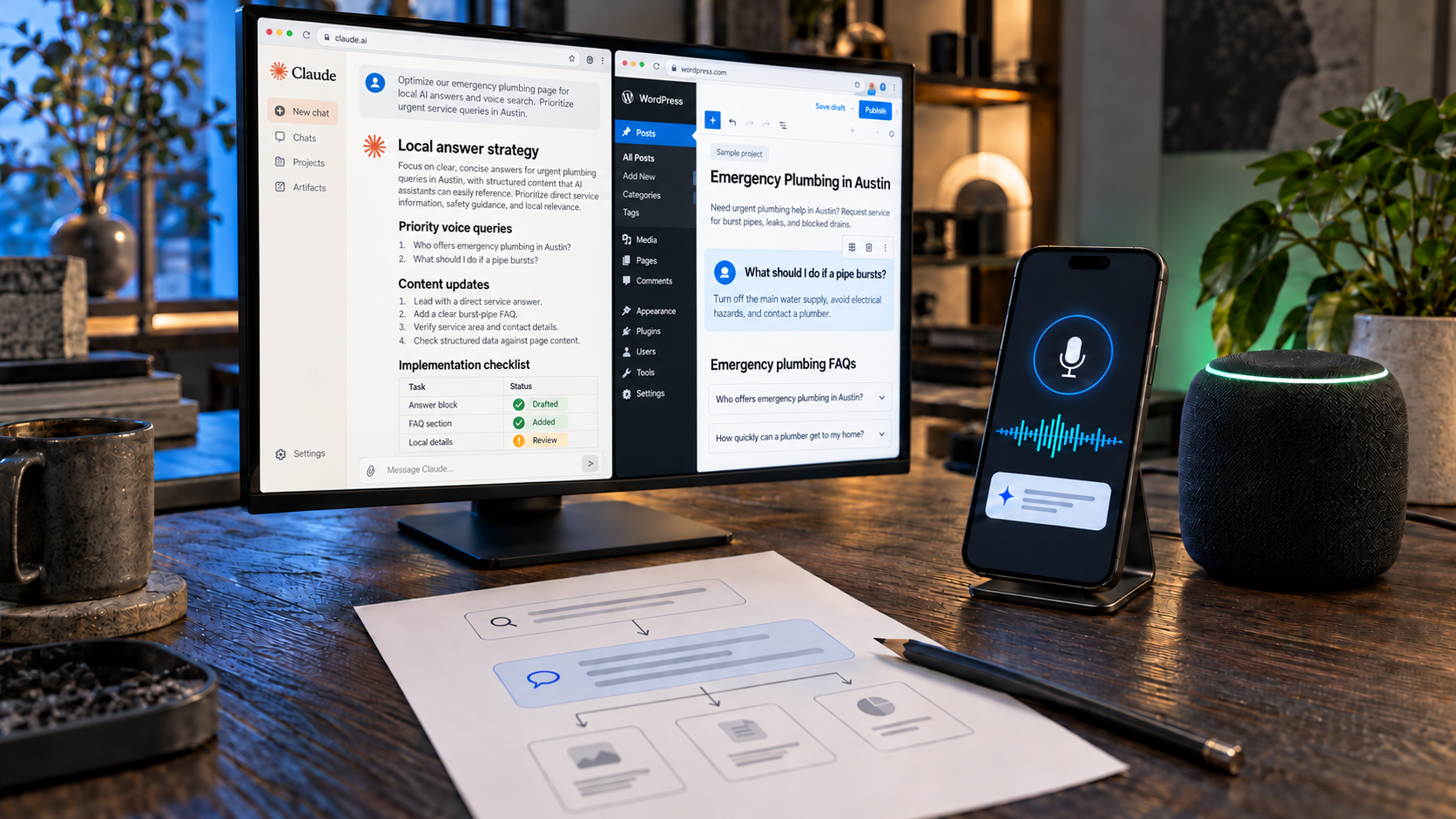
Answer engine optimization (AEO) is the practice of improving how often a business appears in AI-generated answers on engines like ChatGPT, Gemini, and Perplexity. Traffic is down from traditional search, so brands must evolve from search engine optimization to answer engine optimization to remain visible when AI synthesizes authoritative responses.
What is answer engine optimization?
Answer engine optimization is the practice of structuring content so AI-powered search engines select it as the direct answer to a user’s query. The discipline focuses on improving how often and how accurately a business appears in AI-generated answers on engines like ChatGPT, Gemini, and Perplexity.
A fundamental shift in user behavior drives this new discipline. A growing number of users turn to AI assistants to get answers directly, without clicking through to websites. For those users, the question is not which website ranks first. The question is which content the AI cites. Brands that fail to adapt their content for AI citation lose visibility in a channel where only one answer surfaces.
How does AEO differ from traditional SEO?
Traditional SEO optimizes for placement in a list of blue links. AEO optimizes for selection as the single authoritative response an AI engine delivers. The table below highlights the core distinctions.
| Factor | Traditional SEO | Answer Engine Optimization |
|---|---|---|
| Primary goal | Rank in a list of links | Become the cited source in an AI-generated answer |
| User behavior | Users scan results and click | Users receive a direct answer without clicking |
| Success metric | Click-through rate and page-one ranking | Citation frequency and accuracy in AI responses |
Why are AI citations becoming critical for visibility?
The migration to AI-powered search is not a future trend; it is a present reality. Users increasingly expect AI to deliver the definitive answer, personalized and immediate. When an AI engine synthesizes information, it pulls from content it deems most authoritative. Content not structured for this selection process becomes invisible to a rapidly expanding segment of searchers. The cost of inaction is the steady erosion of organic discovery as audiences bypass traditional search results entirely.
Why is AEO strategy critical for visibility?
Answer engine optimization strategy determines whether a brand appears in AI-generated responses or disappears from the consumer’s view entirely. One in ten U.S. internet users now turns to generative AI first for online search, according to Amsive’s 2026 guide, and that share continues to grow. Brands without an aeo strategy forfeit visibility with an audience that never sees a traditional results page.
Consumer expectations have fundamentally shifted. People no longer sift through pages of search results. They expect AI to deliver the definitive answer, personalized and immediate. When a voice assistant or AI engine synthesizes a single response, only the cited sources gain exposure. Everyone else loses the click.
The traffic picture reinforces the urgency. Traditional search traffic is declining, while AI-referred traffic arrives more qualified. These visitors already received context from the AI and arrive with clearer intent. A stable ranking in conventional search no longer guarantees discoverability. As Medium’s analysis of digital marketing shifts notes, brands with steady rankings still feel harder to find because search is no longer about links; it is about answers.
What happens when brands ignore AI-driven search?
Brands that ignore AI-driven search lose qualified traffic before a prospect ever reaches their site. The AI engine answers the query and the conversation ends. No impression, no click, no opportunity to convert.
How does voice search change the discovery equation?
Optimizing for voice search and AI requires structuring content for spoken, conversational queries rather than typed keywords. Voice assistants read one answer aloud. If a brand’s content is not that answer, the brand remains silent.
How do AI engines choose their answers?
AI engines select answers by evaluating content for structure, authority, and direct responsiveness to user questions. These systems differ fundamentally from traditional keyword-based search engines. Amsive’s guide to answer engine optimization notes that AI platforms pull from indexed content to deliver a single authoritative answer rather than a list of options.
The selection process rewards content that is well-structured, authoritative, and directly responsive to user questions. Webflow’s introduction to answer engine optimization explains that AI systems surface, summarize, or link to content meeting these criteria. Content lacking clear structure or direct answers gets overlooked when AI engines synthesize responses.
Google’s generative AI features operate on the same foundation as traditional search ranking systems. Google’s official guidance confirms that generative AI features remain rooted in core Search ranking and quality systems. This means established SEO fundamentals still influence which content AI selects.
What makes content more likely to be cited by AI?
Three characteristics increase citation likelihood:
- Clear structure that AI systems can parse and extract
- Authority established through quality signals and trusted sources
- Direct answers that match the phrasing of user questions
Amsive’s complete guide emphasizes that brands must evolve from search engine optimization to aeo strategy when AI engines synthesize the web’s best information into single answers. The shift from ranking pages to being the cited source changes how content gets evaluated.
How does AI search differ from traditional search?
Traditional search returns a ranked list of links. AI search generates one synthesized answer from multiple sources. Large language models understand user intent and produce responses that combine information from indexed content. This difference means optimizing for voice search and ai requires content formatted for extraction, not just ranking.
What content formats work best for voice queries?
Content that directly answers conversational questions performs best for optimizing for voice search and ai. Well-structured, authoritative material that addresses what people ask aloud gets surfaced, summarized, or linked by AI systems more often.
Answer engine optimization rewards formats built around explicit question-and-answer structures. Amsive reports that consumers check an average of 2.4 platforms when making purchase decisions. Content must therefore function across multiple answer surfaces, not a single search results page.
Which formats do answer engines cite most often?
- FAQ sections with concise, direct answers under each question
- How-to guides that break processes into clear, numbered steps
- Definition blocks that state a term’s meaning in the first sentence
- Comparison tables that organize features side by side for quick extraction
- Short-form explainers that answer one query without digression
Google’s guidance confirms that SEO best practices remain relevant because generative AI features are rooted in core Search ranking and quality systems. A strong aeo strategy builds on that foundation rather than replacing it.
Why do conversational formats outperform traditional pages?
Voice queries arrive as complete questions, not keyword fragments. Content structured to answer those questions directly gives AI engines a clean citation source. Amsive notes that AEO helps brands get cited by ChatGPT, Google AI, and Perplexity when only one answer exists. Formats that bury answers inside lengthy introductions lose that citation opportunity.
Does formatting affect how AI summarizes content?
Yes. Clear headings, short paragraphs, and explicit answer-first sentences make extraction easier for AI systems. Content that opens with a direct response, then expands with supporting detail, aligns with how answer engines select and summarize material.
How do you build a winning AEO strategy?
Building a winning answer engine optimization program demands a fundamental shift in how a brand structures and presents information. The core objective is straightforward: when consumers query AI tools, the brand’s content must be the source those engines find and cite. Traditional rankings are not disappearing, yet a Medium analysis notes they no longer represent the entire picture, and most organizations have not adapted to what replaced the old link-based model.
The engine behind this transformation is a behavioral change. Users moved from sifting through pages of results to expecting direct, curated responses from assistants like ChatGPT, Claude, Perplexity, and Google’s AI Overviews. A firm without an aeo strategy forfeits visibility at the exact moment a potential client asks a high-intent question.
What content formats do AI engines cite most?
AI engines prioritize clear, structured information that resolves a query without ambiguity. Content organized into concise definitions, comparison tables, and direct question-answer pairs performs strongly. Short paragraphs that state a fact upfront, followed by supporting detail, mirror how these models assemble a definitive reply.
Why do traditional rankings no longer guarantee visibility?
A first-page search ranking loses value when the user never scrolls past an AI-generated summary. The shift is from discovery via ten blue links to selection as the single authoritative source. Companies clinging exclusively to legacy keyword tracking watch traffic decline even as rank positions hold steady, because the interface itself has changed.
Reyal Design approaches this landscape as a boutique creative agency built on bold concepts and straightforward execution. The company’s foundation in graphic design and award-winning campaigns supports the visual and structural precision that AI citation engines reward. Optimizing for voice search and AI requires the same clarity and immediacy, structuring answers for spoken delivery where only one result is read aloud. Content optimized for natural language patterns, featuring phonetic simplicity and compact answers, captures the growing volume of hands-free queries flowing through smartphones and smart speakers.
Conclusion
The decision to adopt answer engine optimization is no longer optional for brands that want to remain visible. Content structured for direct extraction, conversational phrasing, and authoritative clarity becomes the cited source when AI synthesizes responses. Every page, FAQ, and guide must answer the question outright, then support it with detail. That shift from chasing rankings to earning citations defines the next step for any organization serious about staying ahead of how consumers now find answers.