

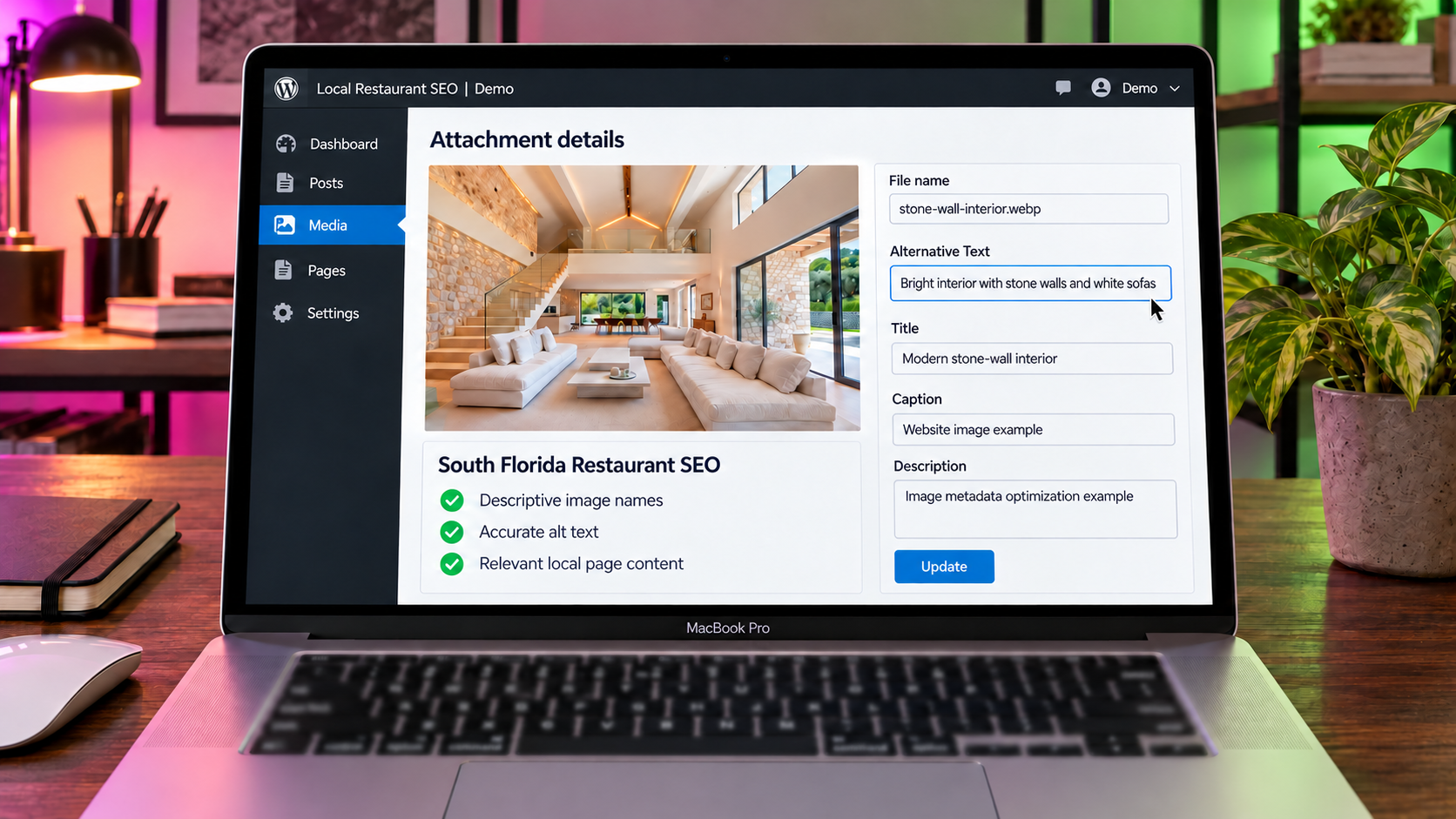
Local Search and Google Business Profile optimization puts South Florida restaurants on the map when diners search “restaurants near me.” With 73% of customers browsing for food online, a complete profile captures those searches. Reyal Design crafts compelling campaigns built around each sector, helping these businesses connect with their target markets effectively.
Why does your restaurant need local SEO?
Local search engine optimization determines whether a South Florida restaurant appears when hungry diners pull out their phones. A DoorDash report found that 73% of customers start browsing for food on an app or online, making a strong digital presence non-negotiable for any dining establishment. Restaurants without optimized local visibility surrender tables to competitors who show up first in search results.
The conversion timeline is startlingly short. Google Consumer Insights data reveals that 76% of mobile searchers visit a restaurant within 24 hours of their search. A Pompano Beach diner searching “seafood near me” at 6 p.m. becomes a seated guest by 7 p.m., but only if the restaurant ranks prominently. Missing that moment means losing revenue that never returns.
Discovery patterns have shifted decisively toward search engines. The DoorDash Trends Report 2026 indicates that 51% of consumers discover restaurants through Google Search. Another 22% use AI tools like ChatGPT or Google Gemini to choose where to eat. Restaurants invisible in search results forfeit over half their potential new customer base before a single menu is viewed.
How many diners check Google before choosing a restaurant?
The figure stands at 93%, according to Malou research on US hospitality behavior. Nearly every potential guest consults Google before making a dining decision. The Google Business Profile appears first in every one of those searches, functioning as the restaurant’s digital front door.
What happens when a restaurant ignores local SEO?
Local restaurant seo strategies directly impact table turnover and nightly revenue. A Fort Lauderdale establishment without optimized listings remains invisible to the 76% of mobile searchers who dine within 24 hours. The 51% of consumers discovering restaurants through Google Search find a competitor instead. With 93% of diners checking Google first, absence from local results translates to empty seats that optimized competitors fill nightly.
What makes a Google Business Profile work?
A Google Business Profile works when it aligns with the three ranking factors Google uses to order local results: relevance, distance, and prominence. South Florida restaurant owners who ignore these factors lose visibility in the map pack, where hungry diners make split-second decisions.
The map pack is driven almost entirely by the Google Business Profile, not by the website. A restaurant in Fort Lauderdale with a polished website but a neglected profile still loses the top three map positions to competitors who maintain accurate, active listings.
However, most profiles we audit are half-complete, have the wrong category, or have not been touched in a year. That neglect carries a direct cost: fewer direction requests, fewer phone calls, and fewer tables filled during peak dinner hours.
Why do Google reviews matter for local rankings?
Google Business Profile, especially Google Reviews, is one of the key sources for being listed on AI tools like ChatGPT. When a diner asks an AI assistant for “best Cuban restaurant in Miami,” the assistant prioritizes restaurants with strong, up-to-date profiles and high review volume.
A South Florida restaurant without recent reviews loses that AI-driven discovery channel entirely. The fix is straightforward: request reviews after every meal, respond to each one, and keep the profile active.
What should a restaurant check first on its profile?
Three elements deserve immediate attention:
- Category accuracy: selecting the correct primary category determines which searches trigger the listing
- Completeness: every field filled, from hours to menu links to photos
- Freshness: regular posts, updated specials, and new photos signal an active business
Local restaurant SEO strategies built around these three factors produce measurable gains in map pack visibility. ## How do South Florida diners use Google Maps?
South Florida diners turn to Google Maps as their primary tool for discovering restaurants. The search behavior is immediate and decisive, with hungry customers opening the app, scanning the top results, and making a choice within seconds.
The pattern is consistent across the region. When people need a local service, they often turn to Google Maps first, searching for restaurants and other businesses near them. A diner in Fort Lauderdale craving Cuban food or a family in Delray Beach hunting for waterfront dining both follow the same path: type the query, glance at the map, and tap the first promising listing. They search phrases like “restaurants near me” or “best tacos in Hollywood,” look at the map, and pick from the top of the list. Scrolling is rare. The decision happens fast, and the restaurants occupying those top three map-pack positions capture the overwhelming majority of the traffic.
What happens when a restaurant is missing from Google Maps?
A restaurant that fails to appear in local map results forfeits more than visibility. The business misses phone calls, website visits, direction requests, and new customers. Every search represents a diner ready to eat, and when a listing is absent, that diner simply selects the next option on the map. The loss compounds daily across breakfast, lunch, and dinner searches.
Why does Google Maps matter more in South Florida than other channels?
South Florida’s tourism-driven dining economy amplifies the importance of map visibility. Visitors unfamiliar with local neighborhoods rely almost exclusively on Google Maps to find meals, and they rarely venture past the first few results. For South Florida businesses, Google Maps stands as one of the strongest lead generation tools available. A restaurant in Boca Raton or Deerfield Beach that optimizes its profile captures both the local regulars and the constant stream of out-of-town guests, turning proximity searches into seated diners within hours.
What are the best local restaurant SEO strategies?
The most effective local restaurant seo strategies combine a fully optimized Google Business Profile with consistent visibility across search and maps. Restaurants that neglect these tactics lose diners to competitors who appear in the top three map results, a position driven almost entirely by profile completeness rather than website authority.
Local SEO for restaurants is the work of earning all three ranking factors: relevance, distance, and prominence. A restaurant’s address is fixed, so the effort goes to relevance and prominence. That means every category selection, photo upload, and review response directly shapes whether a South Florida diner sees the listing or scrolls past it.
Why does a Google Business Profile matter more than a website for restaurants?
Google Business Profile optimization is the single highest-return local marketing task most small businesses never finish. When someone in Pompano Beach searches “best Italian restaurant Fort Lauderdale,” the businesses in the map section capture the majority of calls. Most profiles remain half-complete, carry the wrong category, or sit untouched for a year, silently costing tables every night.
How does restaurant SEO connect to AI-powered search?
Restaurant SEO functions as a digital storefront, giving consistent visibility across Google Search, Google Maps, and AI assistants. Paid ads disappear the moment spending stops. A well-built local presence, by contrast, keeps a restaurant discoverable wherever diners ask for recommendations, whether through a map app or a voice assistant.
Reyal Design partners with ambitious brands to improve their presence, supporting in-house teams and crafting strategic experiences. The company streamlines the marketing process to deliver top-tier strategy and creative services without the overhead of a traditional agency. For South Florida restaurant owners, that translates to a local SEO foundation built for long-term visibility rather than short-term ad spend.
Conclusion
South Florida restaurant owners who act on these three factors (category accuracy, profile completeness, and consistent freshness) claim the map positions that drive real revenue. Every incomplete field or ignored review response hands a table to a competitor. The fix requires no ad budget, only the discipline to treat the Google Business Profile as the primary storefront it has become.